The pattern every business owner recognizes
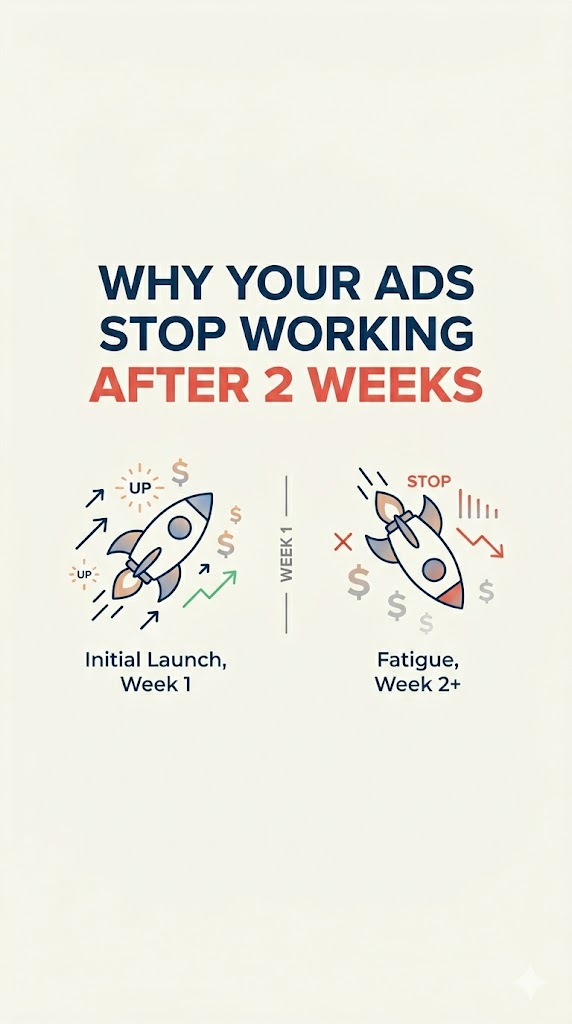
You launch ads. The first few days look promising — clicks, conversions, momentum. Then something shifts. By week two, performance drops. By week three, the ad feels dead. You assume the offer is wrong or the audience has moved on.
The offer is probably fine. What’s actually happening is happening inside your audience’s brain.
What habituation does to your audience
Habituation is one of the most fundamental responses in the human nervous system. When the brain encounters the same stimulus repeatedly, it begins to filter it out — not because the person consciously decides to ignore your ad, but because the brain categorizes it as non-new information.
New information is what the brain is wired to prioritize. Repeated information gets deprioritized automatically.
Research in digital advertising shows cognitive response to a display ad can begin declining after as few as three to five exposures. On social media, where users scroll through high volumes of content daily, that curve is steeper. You can hit diminishing returns within days.
The early performance of an ad creates a false sense of security. What drove those early results wasn’t only your message — it was novelty. Once novelty wears off, only the message remains. And if the message isn’t hitting a deep enough psychological trigger, it fades fast.
Also Read: Why Demographics Aren’t Enough — The Case for Psychological Marketing
The emotional layer most ads miss
There’s a distinction in psychology between cognitive relevance and emotional salience. Cognitive relevance means the person understands the ad is for them. Emotional salience means it actually touches something they’re feeling right now.
Most ads achieve cognitive relevance. Far fewer achieve emotional salience.
Demographics tell you who someone is on paper. They don’t tell you what that person is anxious about this week, what they’re aspiring toward, what identity they’re trying to protect or build. Those psychological variables determine whether an ad feels meaningful or invisible — and they vary significantly even within the same demographic group.
Also Read: Why Businesses Waste $37 Billion on Ineffective Advertising
Three things that actually fix ad fatigue
1. Rotate creative more frequently than feels necessary. Not the offer — the visual presentation, the headline angle, the opening hook. Give the brain something new to process while keeping the core message intact. A practical rule: if your frequency per user exceeds three in a seven-day window, rotate.
2. Shift from demographic to psychographic targeting. Stop asking who your customer is and start asking what they’re feeling. What problem are they sitting with right now? What do they want to be true about themselves? What are they afraid of getting wrong? Ads built around those questions speak to emotional salience, not just relevance — and that sustains attention longer.
3. Think in sequences, not repetition. Instead of running one ad on repeat, structure a conversation. Ad one: awareness of a problem. Ad two: why that problem is costing them. Ad three: a solution. This mirrors how trust builds in real relationships — gradually, through a series of meaningful exchanges, not a single message played indefinitely.
Platforms like ZeroInAI help automate parts of this by building a psychological profile of your audience and using it to inform creative direction and sequencing — keeping messaging relevant past that initial novelty window. But the principles apply regardless of the tools you use.
The bottom line
The brain isn’t ignoring your ad because your product isn’t good. It’s ignoring it because nothing feels new. And new doesn’t mean louder or more expensive. It means more psychologically precise.
Audit your current campaigns against three questions: Is the creative fresh enough to register? Is it touching something emotional rather than just logical? Is it part of a sequence or just repetition? Those answers will tell you exactly what needs to change.