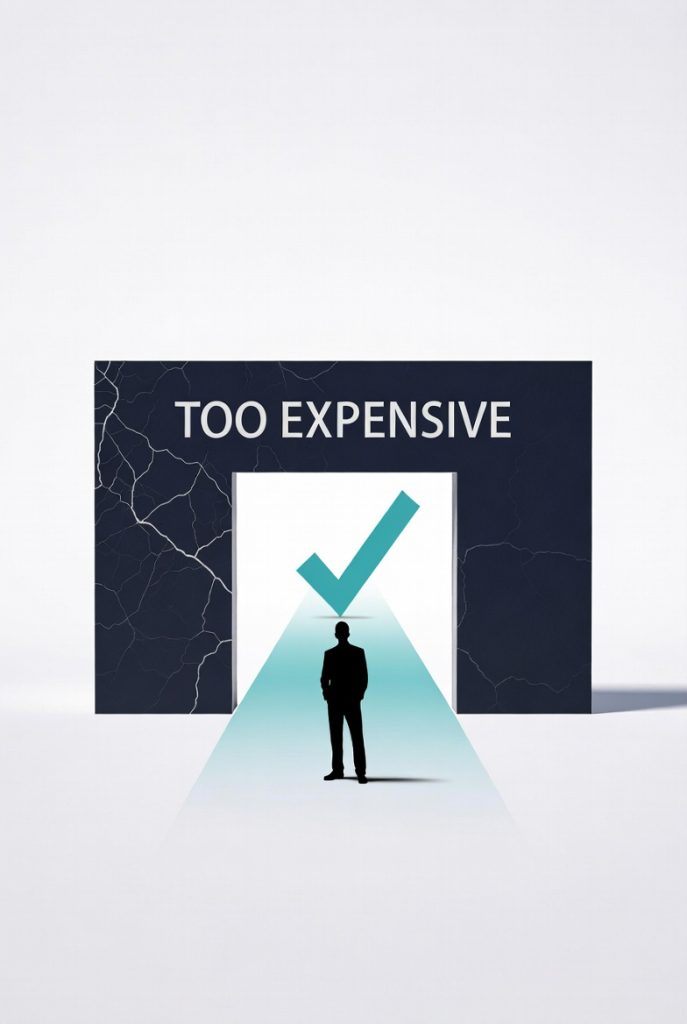
The excuse that costs businesses the most
You lower the price. A few more people convert. But most of the people who said it was too expensive still don’t buy.
That’s the moment most business owners realize price was never actually the problem.
“It’s too expensive” is the most socially acceptable exit available to a consumer. It’s easy to say, hard to argue with, and lets both parties walk away without an uncomfortable conversation. But underneath that exit is something else entirely — a feeling that stopping is safer than moving forward.
Understanding that feeling is the difference between a business that keeps chasing discounts and one that fixes the real problem.
What the brain is actually doing
The human brain is not wired to maximize gain. It’s wired to minimize loss. Behavioral economists call this loss aversion — and decades of research confirm it’s one of the most powerful forces in human decision-making. The pain of losing something is psychologically about twice as powerful as the pleasure of gaining something of equal value.
What this means in practice: when someone is close to a purchase and something feels uncertain, the brain doesn’t weigh the potential upside against the potential downside equally. The downside gets disproportionate weight. And the safest way to avoid a bad outcome is to do nothing.
This is decision friction. It’s not skepticism about your product. It’s the brain’s risk management system activating at the moment of commitment. And it happens regardless of price — because the friction isn’t about the number. It’s about uncertainty.
Lower the price and you’ve addressed the stated objection. You haven’t addressed the underlying one.
Also Read: Why Your Ads Stop Working After 2 Weeks
The three sources of friction that kill conversions
Most conversion problems trace back to one or more of three things.
Unclear transformation. The customer can’t picture what their life or business looks like after buying. They understand what the product does in a functional sense. But they can’t feel the outcome. And if they can’t feel it, they can’t commit to it. Vague outcome language — “improve your marketing,” “grow your business,” “save time” — leaves too much for the imagination to fill in. And what the imagination fills in is usually doubt.
Trust deficit. The customer hasn’t seen enough evidence that this works for someone like them. Generic social proof — star ratings, testimonial counts, logos of recognizable companies — creates some credibility. But it doesn’t answer the question the buyer is actually asking: has this worked for someone in my situation, with my level of experience, my type of business, my starting point? When the answer to that question isn’t clear, the brain defaults to caution.
Choice overload. The path to yes requires too many decisions. Three pricing tiers with different feature sets. Multiple package options. Upsells presented before the initial commitment is made. Every decision point you add before checkout is another moment where the brain can say “this is getting complicated” and stop. Complexity feels like risk. Simplicity feels like safety.
Each of these creates cognitive load. And high cognitive load has a consistent outcome: inaction. The brain conserves energy by choosing the default — and the default is always to do nothing.
Also Read: Why Demographics Aren’t Enough — The Case for Psychological Marketing
How to remove friction without touching your price
The goal isn’t to overwhelm people with information. It’s to remove the specific uncertainties that are activating their risk management system.
Make the transformation concrete. Replace vague outcome language with specific, measurable, time-bound results. Not “improve your ad performance” but “know exactly which message your best customer responds to, before you spend another dollar testing.” The more precisely you can describe the outcome, the less room there is for doubt. Specificity signals that you’ve actually delivered this result before — which is itself a trust signal.
Use proof that mirrors your buyer. One detailed case study from someone who shares your buyer’s situation, starting point, and industry will outperform ten generic testimonials. People don’t need to see that your product works. They need to see that it works for someone like them. When they can see themselves in the proof, the trust deficit closes faster than any volume of social proof can close it.
Audit your path to yes. Map every decision a customer has to make between landing on your page and completing a purchase. Every single one. Then ask which decisions are necessary and which exist because nobody removed them. The goal is one clear offer, one clear next step, and as few decisions in between as possible. If you’re presenting three pricing tiers, ask whether you actually need three — or whether two creates enough differentiation without the added friction of a harder choice.
Address objections before they form. Most conversion copy is written from the seller’s perspective — what the product does, why it’s good, what it includes. The buyer’s perspective is different. They’re asking: what if this doesn’t work for me? What if I regret this? What if it’s more complicated than it looks? Those questions are forming in the background of every buying decision. The copy that anticipates and answers them directly — before the buyer has to ask — removes friction at the source.
This is where understanding your audience’s psychological profile becomes a real competitive advantage. Not their demographics. Their actual objections, fears, and decision patterns. Platforms like ZeroInAI surface these from behavioral data, so they can be addressed in messaging rather than discovered through lost sales.
The 30-second test
Take your offer page and give yourself 30 seconds to read it as if you’ve never heard of your business before.
At the end of those 30 seconds, you should be able to answer three questions clearly: What exactly do I get? What specifically changes for me? Why should I trust that this works?
If any of those answers require more than 30 seconds to find, that’s where your conversions are dying.
Not at the price. At the friction.
What this means for your marketing
Price objections are almost always a symptom. The cause is somewhere in the experience — a transformation that wasn’t made tangible, a trust signal that didn’t land, a decision that didn’t need to be there.
Fix those things and you’ll find that your price stops being the issue. Not because you lowered it. Because you made the value clear enough and the path easy enough that the risk of doing nothing started to outweigh the risk of moving forward.
That’s the real conversion problem. And it’s solvable without a discount.