A/B testing is widely considered a core pillar of modern digital marketing. From optimizing landing pages to improving email campaigns, it promises a data-driven way to increase conversions and overall performance. But here’s the reality many marketers overlook: not all A/B testing is worth the investment. In fact, once you move beyond foundational improvements, excessive testing can lead to minimal gains, wasted budget, and slower decision-making. Understanding when A/B testing delivers real value—and when it doesn’t—is critical for making smarter marketing decisions.
1. Diminishing Returns in A/B Testing
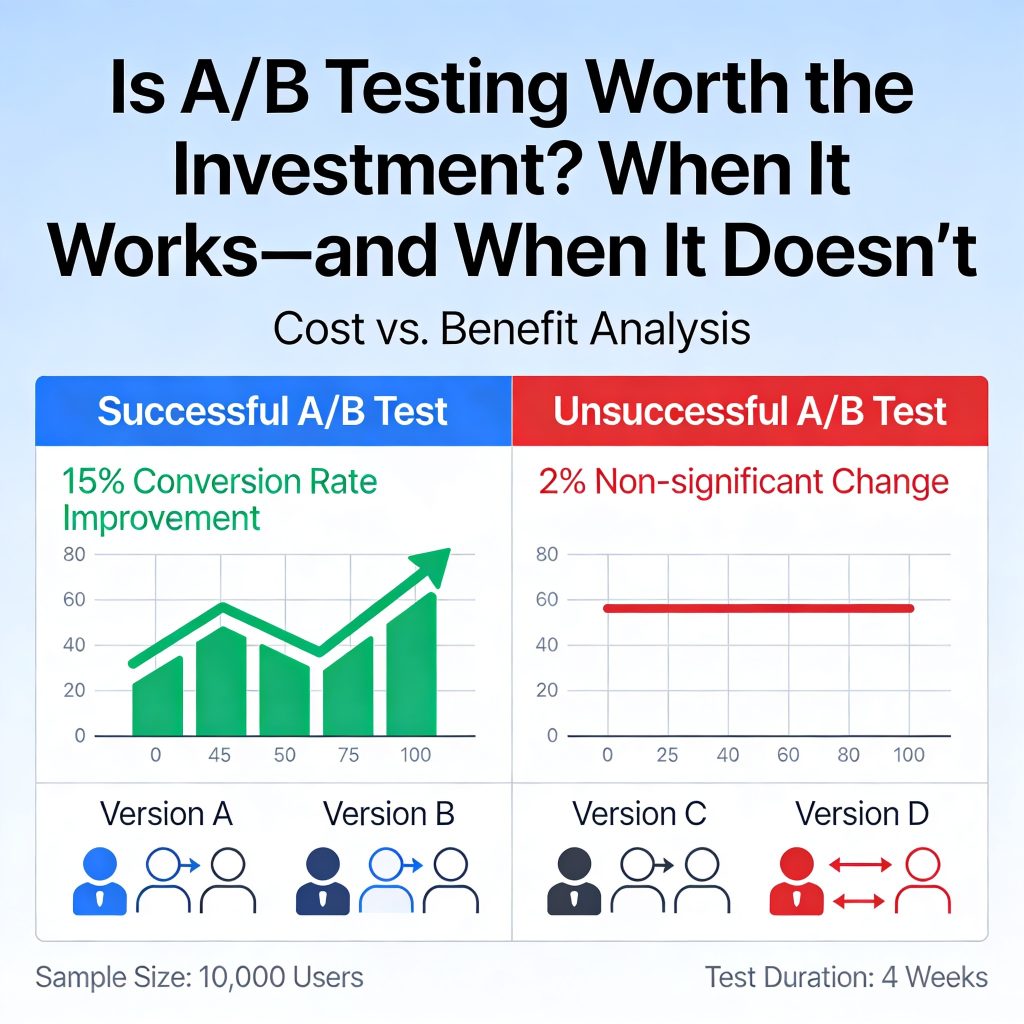
A/B testing delivers the highest impact when applied to high-leverage elements such as your core messaging, value proposition, primary call-to-action, or overall offer structure. These are the components that directly influence user behavior and conversion rates. However, once these core elements are optimized, the law of diminishing returns begins to take effect. At this stage, further testing tends to focus on micro-optimizations like button colors, minor wording changes, or font variations. These types of changes rarely produce meaningful improvements and often result in statistically insignificant differences. As a result, the return on investment drops sharply, making continued heavy investment in testing difficult to justify.
2. Over-Testing Leads to Analysis Paralysis
Another major issue arises when marketers have large budgets dedicated to testing: the temptation to test everything. While this may seem like a thorough approach, it often leads to overcomplication. Running multiple experiments simultaneously across different variables can create noisy data and conflicting results that are difficult to interpret. Instead of gaining clarity, teams become overwhelmed with too much information. This leads to what is commonly known as analysis paralysis—where the abundance of data actually slows down decision-making rather than improving it. In such cases, A/B testing stops being a tool for clarity and becomes a source of confusion.
Also Read: The Art of Ad Intelligence: Turning Google Ads Competition Into Your Greatest Asset
3. The Hidden Opportunity Cost
Beyond complexity, there is also the question of opportunity cost. Every dollar allocated to A/B testing is a dollar that cannot be invested elsewhere. While testing may yield incremental improvements, it is important to evaluate whether those improvements are the best possible use of your resources. In many cases, investing in customer acquisition, exploring new marketing channels, strengthening your brand, or improving your product offering can generate far greater returns. These initiatives often drive long-term, scalable growth, whereas excessive testing typically leads to small, short-term gains. Focusing too heavily on optimization can limit strategic thinking and shift attention away from more impactful growth opportunities.
4. Time, Resources, and Execution Costs
It is also important to consider the hidden costs associated with A/B testing. Beyond financial investment, testing requires significant time and human resources. Each experiment involves forming a hypothesis, designing variations, implementing changes, collecting sufficient data, and performing analysis. This process can be especially demanding for small teams with limited capacity. Additionally, reaching statistical significance often takes time, particularly if your traffic volume is not high. During this period, market conditions, user behavior, or competitive dynamics may shift, reducing the relevance of your findings. In fast-moving environments, speed and adaptability often matter more than incremental accuracy.
Also Read: AI Target Audience Identification: Guide for Marketers
5. When A/B Testing Actually Makes Sense
That said, A/B testing is far from useless. When used strategically, it remains one of the most powerful tools for performance optimization. It is most effective when you have sufficient traffic to reach reliable conclusions, when you are testing major variables rather than minor tweaks, and when you have a clear hypothesis guiding the experiment. Equally important is the ability to act quickly on the results. Without execution speed, even the most accurate insights lose their value.
Also Read: What is statistical significance?
6. Final Verdict
In conclusion, A/B testing should be viewed as a tool—not a strategy in itself. When applied thoughtfully to the right areas, it can unlock meaningful improvements and drive measurable growth. However, when overused or misapplied, it can quickly become a drain on time, budget, and team resources with little to show in return. The most effective marketers are not the ones who test everything, but the ones who understand what is truly worth testing and focus their efforts accordingly.